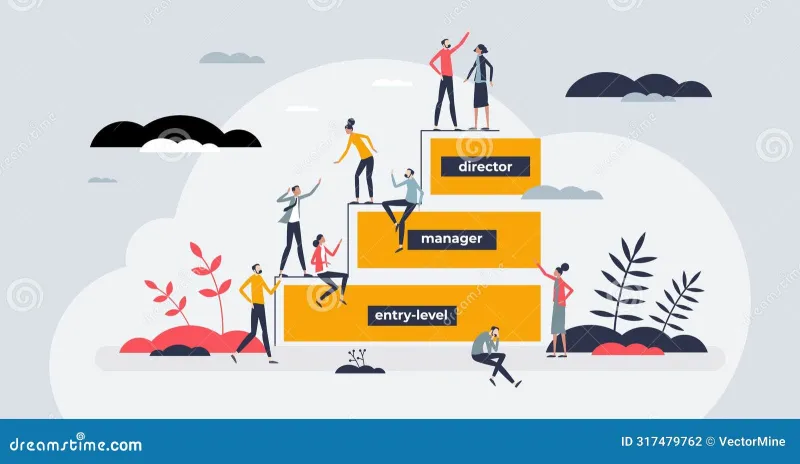
Climbing the Ladder Shouldn't Mean Leaving Your Best Ideas Behind

Photo: professional climbing career ladder office creative thinking, via assets3.cbsnewsstatic.com
The Moment Everything Changes
There's a specific inflection point that happens in a lot of careers, and it usually goes unnoticed until the damage is already done. An employee spends years being the one who pushes back, tries weird things, proposes ideas that make the room go quiet before the lightbulb goes on. They're scrappy, creative, a little unpredictable in the best possible way. Leadership notices. They get promoted.
And then, almost imperceptibly, they stop.
Not overnight. Not dramatically. But within a few quarters, the person who used to pitch the unconventional approach is now the one defending the status quo. The one who used to experiment is now the one asking for more data before anything moves forward. The promotion didn't reward their innovation — it accidentally retired it.
This is the promotion trap, and it's eating your pipeline of new ideas from the inside out.
Why the Ladder Works Against You
Traditional career advancement is built on a pretty simple premise: perform well, move up, gain authority. The problem is that "performing well" at higher levels of most organizations means something entirely different than it did on the way up.
At the individual contributor level, creative risk-taking is often celebrated. You try something, it works (or it fails interestingly), and you learn. At the management or senior leadership level, the incentive structure quietly flips. Now you're accountable for other people's outcomes. You're in meetings where you're expected to project confidence, not curiosity. You're managing budgets, timelines, stakeholder relationships. The organizational gravity pulls hard toward predictability.
It's not that your promoted stars suddenly become boring people. It's that the environment they've stepped into systemically rewards caution and punishes the kind of experimental thinking that got them noticed in the first place. Conformity gets rebranded as "maturity." Risk aversion gets called "strategic thinking." And slowly, the innovator becomes the gatekeeper.
The Hierarchy Hangover
Here's something worth sitting with: most American companies still run on an organizational model that was essentially designed for manufacturing in the mid-20th century. Layers of management exist to coordinate, control, and reduce variance. That's useful when you're trying to get a thousand widgets off an assembly line with zero defects. It's actively counterproductive when you're trying to generate fresh thinking in a knowledge economy.
When creative people get absorbed into that hierarchy, they don't just lose the permission to experiment — they often lose the time for it. Senior roles come loaded with administrative overhead: performance reviews, cross-functional syncs, budget cycles, compliance sign-offs. The cognitive bandwidth that used to go toward asking "what if we tried this?" now goes toward keeping the machine running.
And here's the real gut punch: the people filling those senior roles usually know exactly what's happening. They can feel themselves becoming less innovative. But the system doesn't give them a clean exit ramp. You either keep climbing, or you feel like you're falling behind.
Rethinking What "Getting Ahead" Actually Means
Some companies are starting to challenge the assumption that advancement has to mean moving into management. The dual-track career model — where employees can grow along a technical or creative track with equivalent compensation and prestige to the management track — is gaining real traction, especially in tech and design-forward organizations.
The idea is straightforward: not everyone who's brilliant at their craft should be running a team. And forcing them to do so in order to earn a bigger title and a better salary is a bad deal for everyone. The company loses a great individual contributor and gains a reluctant, often struggling manager. The employee loses the work they loved and gains a job they didn't actually want.
Companies like Spotify and Patagonia have experimented with variations of this model, carving out "individual contributor" paths that let people deepen their expertise and grow their impact without taking on people management responsibilities. The result, when it works, is that you preserve the creative engine that made those people valuable while still giving them room to grow.
Innovation Needs a Dedicated Address
Another piece of this puzzle is structural. If you want senior people to keep innovating, you have to build dedicated space for it — not just encourage it in theory and then schedule it out of existence.
That might look like protected time for experimentation (Google's famous 20% time gets cited constantly, but the underlying principle is sound even if the execution varies). It might look like internal "skunkworks" teams where senior contributors can step out of their day-to-day roles and work on longer-horizon problems. It might look like explicitly carving innovation goals into performance reviews so that creative risk-taking is actually measured and rewarded, not just talked about.
The key is making it structural, not motivational. You can't fix a system problem with a pep talk. If the environment punishes experimentation, telling people to "be more creative" is just noise.
What Managers Can Do Right Now
You don't have to overhaul your entire org chart to start pushing back against the promotion trap. There are smaller moves that can make a real difference.
Have the conversation before the promotion. When you're thinking about moving someone up, talk openly about what they'll be gaining and what they might miss. Ask them what they want their day-to-day to actually look like. Don't assume the title is the point.
Audit your senior team's creative output. When did your most experienced people last propose something genuinely new? If the answer is "I can't remember," that's data. Something in the environment is shutting that down.
Create low-stakes experimentation channels. Give people a place to try things that isn't tied directly to quarterly targets. A small budget, a side project, a cross-functional working group with genuine autonomy. Make it safe to be wrong at small scale.
Reward the attempt, not just the outcome. If the only experiments that get recognized are the ones that succeed, you're not building an innovative culture — you're building a culture of calculated bets. Real innovation requires tolerating failure, and that starts with how leadership talks about and responds to it.
The Bigger Picture
The companies that are going to win the next decade of talent competition aren't the ones offering the most rungs on the ladder. They're the ones rethinking what the ladder is even for.
Your best people don't just want to move up. They want to keep doing work that matters, work that challenges them, work where they can see their fingerprints on something real. If your advancement model asks them to trade that in for a fancier title and a bigger slice of administrative overhead, a lot of them are going to quietly start looking for somewhere that doesn't make them choose.
Promotion should feel like an expansion, not a trade-off. The organizations that figure out how to make that true are the ones that will actually hold onto the people worth keeping.