When Winning at Your Job Means Getting Punished With a Worse One
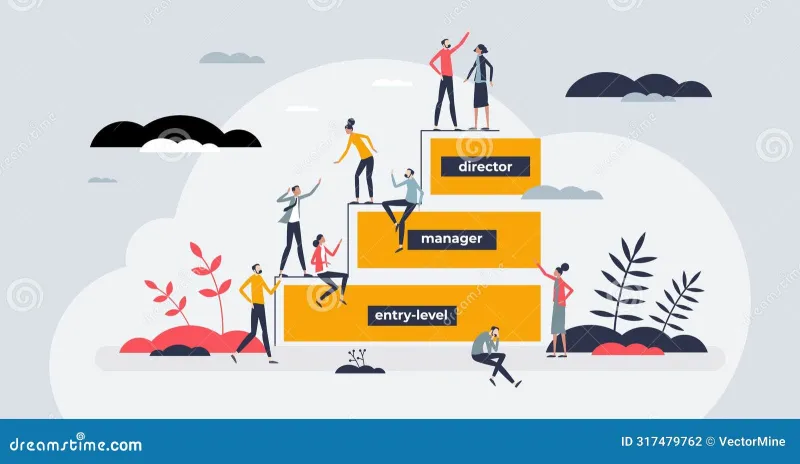
Photo: employee career ladder promotion office professional development, via thumbs.dreamstime.com
The Accidental Manager Problem Nobody Wants to Talk About
Picture this: your top engineer has shipped more reliable code than anyone else on the team for three straight years. She knows the product inside and out, mentors junior devs without being asked, and her pull requests are basically masterclasses. So you promote her to engineering manager.
Six months later, she's miserable. Her team is confused. And your best technical mind is now buried under one-on-ones, performance reviews, and Slack messages about vacation policy.
This is the promotion trap. And it's playing out in companies across the country every single day.
The logic behind it feels airtight: reward excellence with advancement. But there's a quiet assumption baked into that logic — that advancement means management. And that assumption is quietly wrecking teams, burning out talented people, and costing companies the very output that made those individuals so valuable in the first place.
Why Technical Excellence and Leadership Are Two Very Different Skill Sets
Being great at a job and being great at helping other people do that job are not the same thing. Not even close.
Individual contributor roles — whether you're a software engineer, a sales rep, a designer, or a financial analyst — reward personal execution. You get better at doing. Management, on the other hand, is almost entirely about enabling, communicating, navigating ambiguity, and making decisions with incomplete information about people, not systems.
"I thought I knew what I was getting into," says Marcus, a former senior data scientist at a mid-size fintech firm who was promoted to analytics manager in 2021. "I was wrong. Within three months I realized I hadn't written a single line of code. I was just in meetings arguing about headcount and trying to figure out why two people on my team weren't getting along."
Marcus isn't an outlier. Research from Gallup has consistently found that one of the primary reasons employees leave companies isn't pay or workload — it's bad managers. And a significant chunk of those bad managers aren't bad people. They're good individual contributors who were handed a job they were never set up to succeed in.
The One-Ladder Problem
Traditionally, corporate career structures look like a single ladder. You start at the bottom, you climb, and eventually the rungs lead to managing people. If you want more money, more status, more influence — you go up. And up means managing.
For decades, that was just how it worked. But that structure made more sense when knowledge was siloed, when the hierarchy was the communication channel, and when companies didn't depend so heavily on deep technical expertise.
Today, a senior staff engineer at a company like Stripe or Google can have more strategic impact on the product than most directors. A principal designer can shape user experience at a scale that outpaces entire teams. Forcing those people up a management ladder doesn't just misuse their skills — it actively removes them from the work they're best at.
"We were essentially paying a tax on our own talent," says Jenna, a VP of Product at a Chicago-based SaaS company that revamped its career pathing in 2022. "We'd develop someone into a world-class product thinker and then promote them into a role where they spent half their time in HR conversations. It made no sense."
Her company introduced a dual-track system — one path for people managers, one for individual contributors — with comparable compensation bands, titles, and visibility at each level. The result? Lower attrition among senior ICs, faster product velocity, and managers who actually wanted to be managers.
What Companies Are Doing Differently
The dual-track model isn't new in tech. Companies like Spotify, Basecamp, and various consulting firms have used some version of it for years. But it's spreading into industries that historically clung hard to the single-ladder model — finance, healthcare administration, manufacturing operations.
The core idea is simple: create a senior IC track that offers real advancement — better pay, more autonomy, higher-profile projects, a seat at strategic tables — without requiring someone to take on direct reports.
But structure alone isn't enough. Companies that do this well also invest in two other things:
1. Honest conversations before the promotion. The best organizations don't just offer a choice between tracks — they actually talk through it. They ask questions like: Do you get energy from developing other people, or does that drain you? How do you feel about spending most of your day on communication rather than craft? These aren't trick questions. They're calibration tools.
2. Real transition support for new managers. For people who do choose the management path, the difference between success and failure often comes down to whether the company actually prepares them. A title change on a Monday morning is not preparation. Structured manager training, peer cohorts, executive coaching, and a grace period where new managers are expected to learn — not just perform — can change the trajectory dramatically.
"The first year of management is genuinely hard," says Marcus, who eventually moved back into an IC role and says it was the right call. "If someone had just told me what I was actually signing up for, I might have made a different choice. Or at least I would've gone in with better expectations."
The Hidden Cost of Getting This Wrong
When companies default to the old model — promote the best, watch them struggle — the costs are real and they compound.
First, you lose the output of your top performers. A brilliant engineer who becomes a mediocre manager isn't adding the value they used to. The team under them often suffers from unclear direction, inconsistent feedback, and a manager who's quietly frustrated and checked out.
Second, the manager themselves often ends up leaving. Either they burn out, or they realize the role isn't right and go find a company where they can go back to doing what they're good at. Either way, you've lost them.
Third — and this one's underappreciated — it sends a signal to everyone else watching. When your high performers see a colleague get promoted into misery, they start doing the math on their own futures. Some will decide that advancement isn't worth it. Others will quietly start looking for companies that give them a different option.
Rethinking What Advancement Actually Means
The deeper issue here is cultural. We've spent so long equating management with success that it's hard to see senior IC roles as genuinely prestigious. That's changing — but slowly, and mostly in industries where technical depth is visibly tied to business outcomes.
For companies that want to get ahead of this, the work is partly structural (build the dual track, align the comp bands) and partly narrative (make it clear, loudly and repeatedly, that being a principal engineer or a senior strategist or a lead designer is a real win — not a consolation prize for people who couldn't hack management).
That narrative shift is harder than drawing up a new org chart. It requires leaders to model it, managers to reinforce it, and the company to actually back it up with resources and visibility.
But here's the thing: the organizations that figure this out aren't just being nice to their employees. They're building teams where the right people are in the right roles — and that's where the real performance gains live.
The promotion trap is real. But it's not inevitable. It's a design problem. And design problems, by definition, can be redesigned.